
Handforth Prisoner of War Camp


In early November 1914 the print works buildings of Handforth were converted into an interment camp for Prisoners of War. The buildings had originally been built in 1910 by the Bradford Dyers Association to accommodate their print works, but remained empty and never saw that business. Early in 1914 The Lancashire Rubber Co purchased the building intending to use it as a synthetic rubber plant. Again, projected work never came to the site and it was reported that the German proprietor of that venture was an early inmate.
Upon the outbreak of war the local Army Command decided to use the buildings as barracks for 2,000 troops of the Manchester Regiment (3rd and 4th battalions), yet the war office had other ideas and they requisitioned the buildings for a POW camp designed to accommodate 1,000 and at its peak in December 1916 it was catering for 2948 sailors and soldiers.
The arrival of the first 500 civilian interns on 4th November 1914 was a big event for the villagers of Handforth. Local residents frequently visited the camp to try and see the prisoners with large crowds gathering on weekends. During the camp’s period of occupation between November 1914 and 1919the prisoners included 573 from German East Africa, 260 who were survivors of the battle cruiser Blucher and 600 soldiers captured in the trenches of Neuve Chapelle.
Handforth Railway Station


Originally opened in 1842 by the Manchester and Birmingham Railway, Handforth would have been viewed in those days as a hamlet. The station consisted of just wooden buildings with slate tiled roofs. The original intention was to have both platforms on the north side of the road bridge. This was abandoned in favour of building a coal wharf opposite the north platform, so the Crewe platform had to be relocated on the south side of the road bridge. The only brick constructions comprised the station master’s house, signal box and lamp room.
Handforth station played an important part in both world wars. In WW1 detainees arrived for Handforth’s POW camp and, in WW2, countless numbers of servicemen and women passed through on their way to military camps dotted around Handforth. Tony Edwards.
Goods Traffic
Coal for the community and raw materials for industry were handled in sidings at the station. WW2 traffic for the Air Ministry and War Department depots was dealt with at a new goods yard a half mile to the north from where branches received and dispatched aeroplane spares and armoured vehicles. Paul Teather.
Friends of Handforth Station (FoHS)
In 1995 the local community and passengers feared that the station would be closed. Handforth station’s 1960s building had started to leak and staff had been withdrawn. FoHS was formed as a local community group to ’adopt’ the station and take action. This resulted in a new staffed ticket office, CCTV and waiting shelters. Many local people of all ages have been involved in enhancing the station, including
gardens on the platforms and frontage. FoHS has also created a ‘Platform for Art’, with artworks regularly appearing across the station. FoHS continues to campaign for better access at the station.
Further information on FoHS and the station can be found at www.handforthstation.org.uk and on the Community
Notice Board on the station forecourt. Mike Bishop. Andrew Backhouse.
Site of Handforth’s village green.


During World War II much of the the green, was occupied by huts comprising administrative offices of RAF 61MU (top right). The Health Centre and the Library that now occupy the site were built in 1975. The Health Centre was purchased from local GPs in 1992 and was then completely refurbished. The Library is listed by Cheshire East Council as a non-designated heritage asset.
Site of the Greyhound Inn
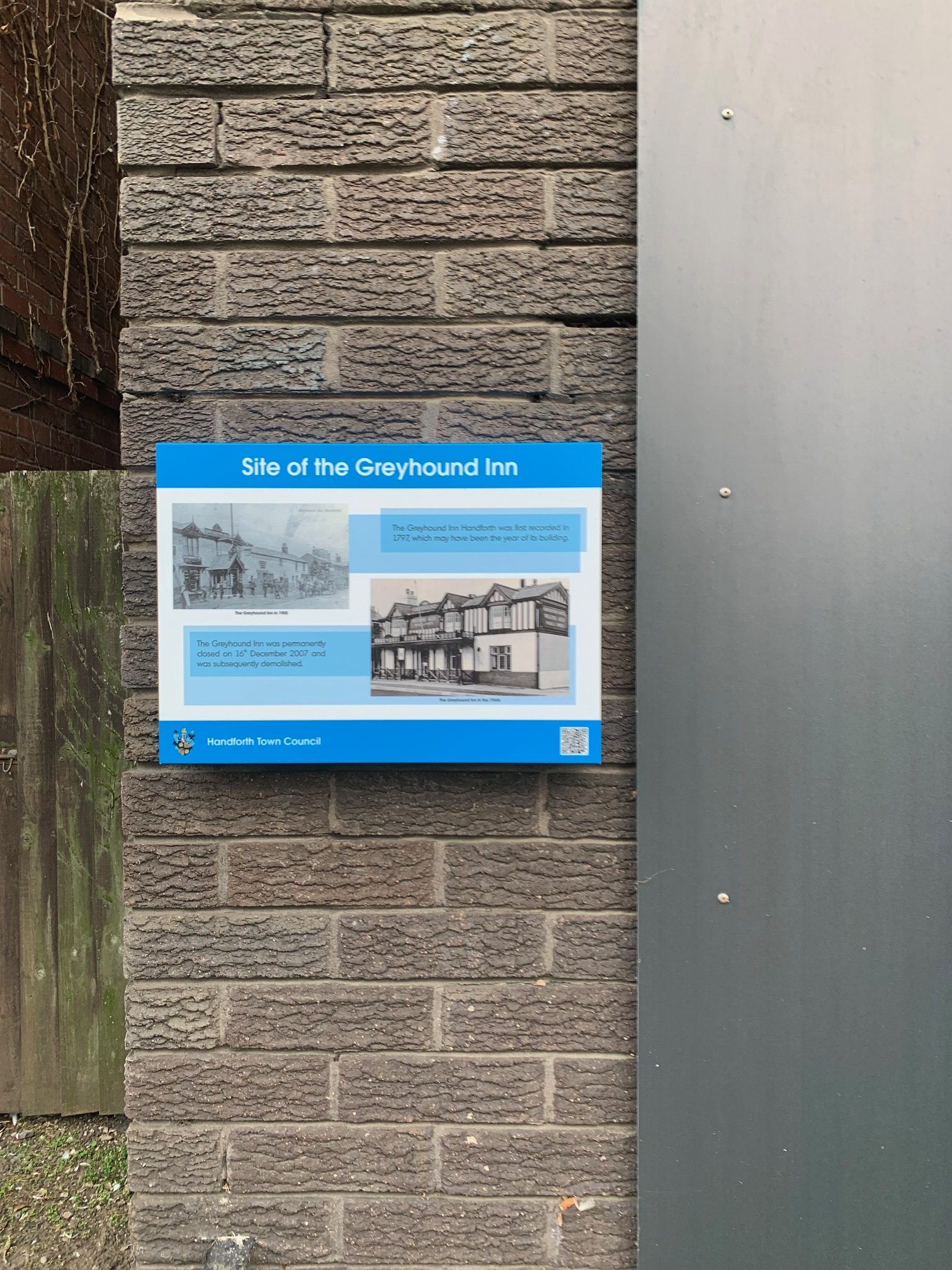
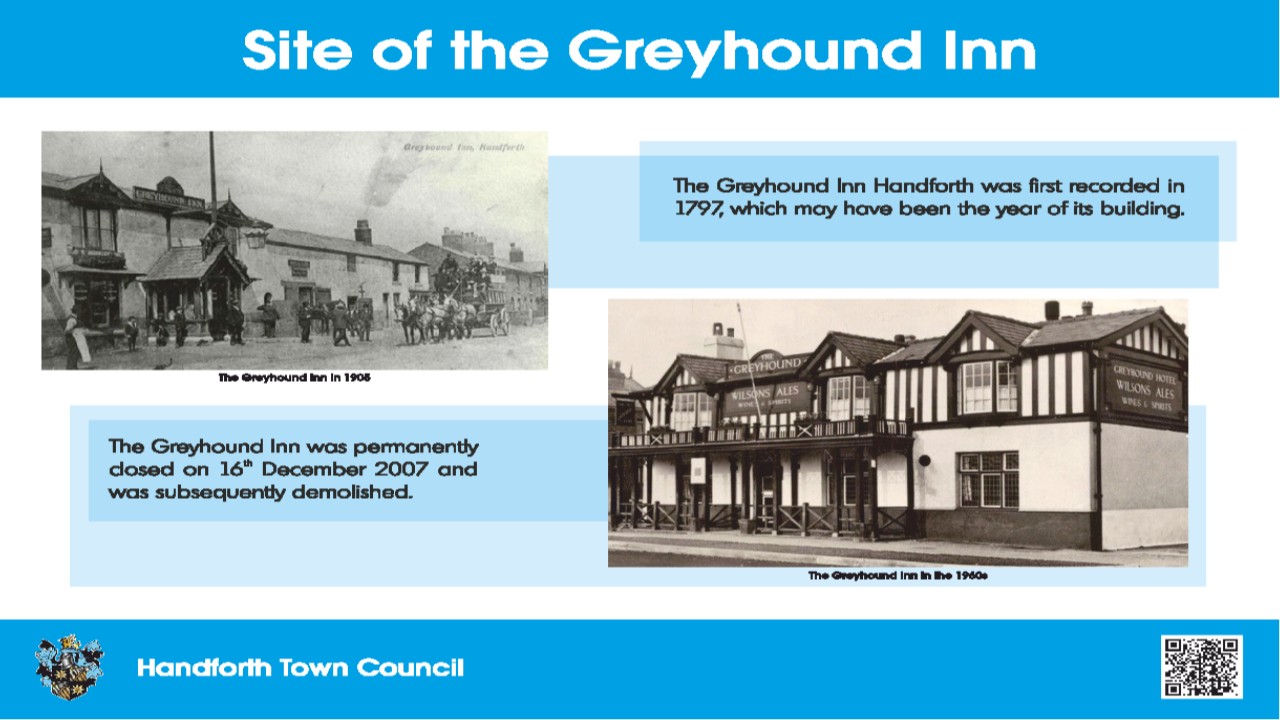
The Greyhound Inn Handforth was first recorded in 1797, which may have been the year of its building.
The Greyhound Inn was permanently closed on 16th December 2007 and was subsequently demolished.
Brooke Farmhouse

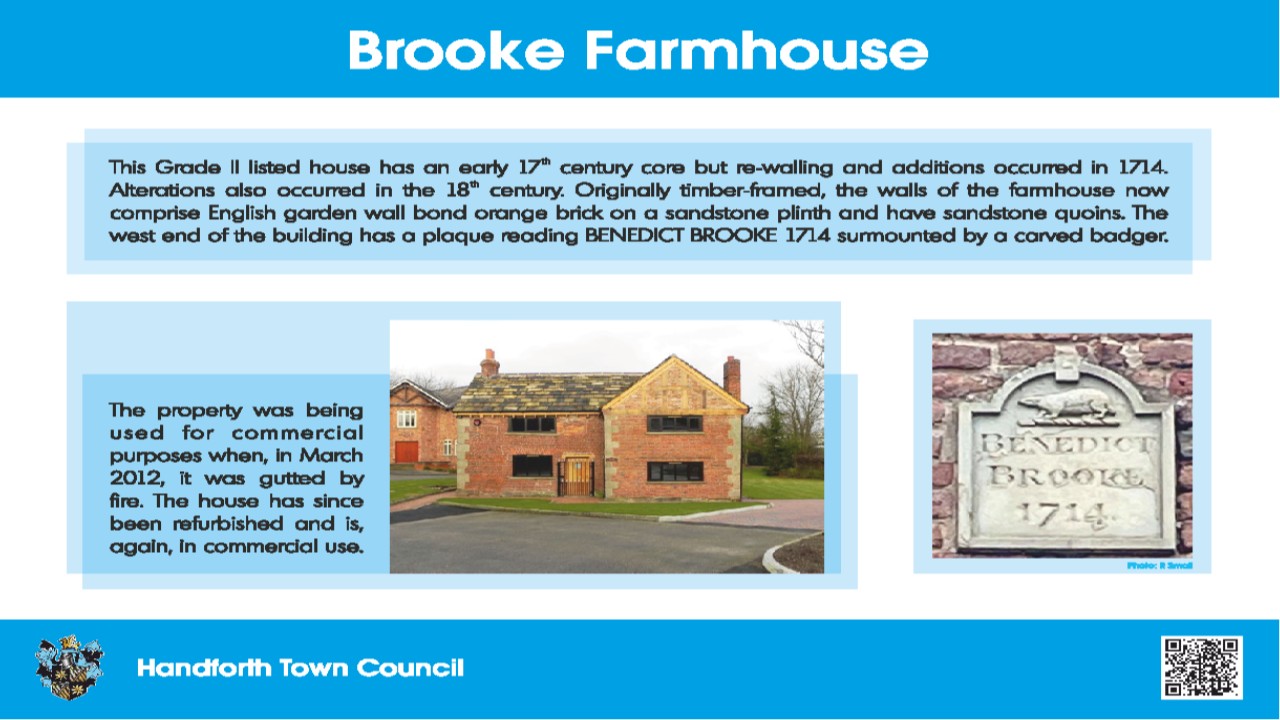
This Grade II listed house has an early 17th century core but re-walling and additions occurred in 1714. Alterations also occurred in the 18th century. Originally timber-framed, the walls of the farmhouse now comprise English garden wall bond orange brick on a sandstone plinth and have sandstone quoins. The west end of the building has a plaque reading BENEDICT BROOKE 1714 surmounted by a carved badger.
The property was being used for commercial purposes when, in March 2012, it was gutted by fire. The house has since been refurbished and is, again, in commercial use.
The White House


(180,182,184 and 186 Wilmslow Road)This Grade II listed building formerly comprised a Methodist chapel (the northerly cross wing of the
building) and a Sunday school (the southerly cross wing of the building). The central part of the building comprised two houses, each being entered from Wilmslow Road by means of three stone steps with iron balusters. The chapel dates from c1840 and the Sunday school from 1873. The entire building has been refurbished and converted into an apartment block.
The southern most house at No. 187 Wilmslow Road


A Grade II listed former farmhouse dated 1720 and 1752 with some later alterations and additions. The central bay has a lean-to porch with a wooden doorframe, the lintel of which is inscribed JMM 1752. The porch has a studded board door. There is a single storey extension to the right. The house and garden have recently been refurbished. In the early 1970s the house was being used as a doctor’s surgery.
Site of the Stationmaster’s House
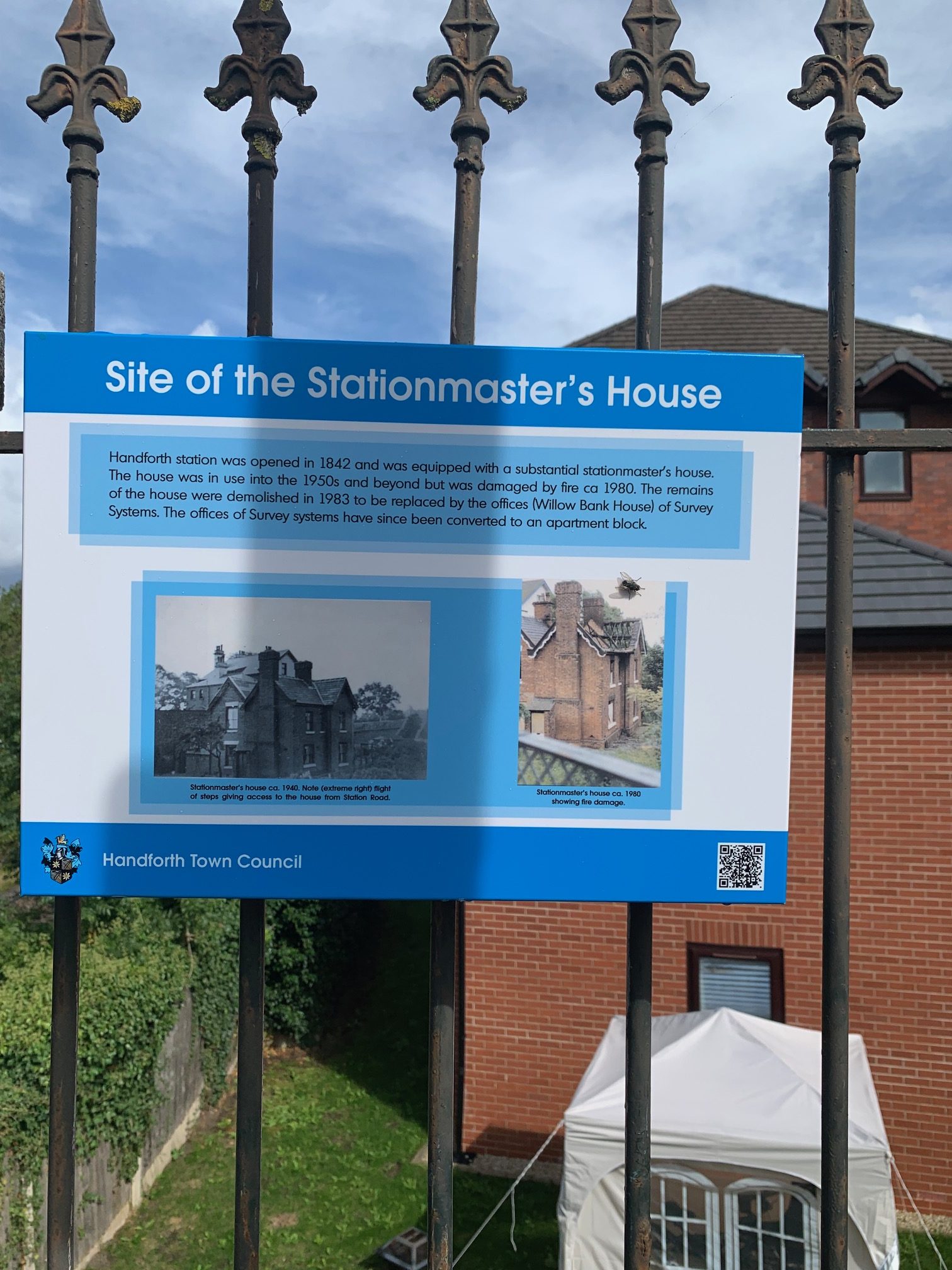

Handforth station was opened in 1842 and was equipped with a substantial stationmaster’s house. The house was in use into the 1950s and beyond but was damaged by fire ca 1980. The remains of the house were demolished in 1983 to be replaced by the offices (Willow Bank House) of Survey Systems. The offices of Survey systems have since been converted to an apartment block.
Site of Handforth’s Chapel of Ease

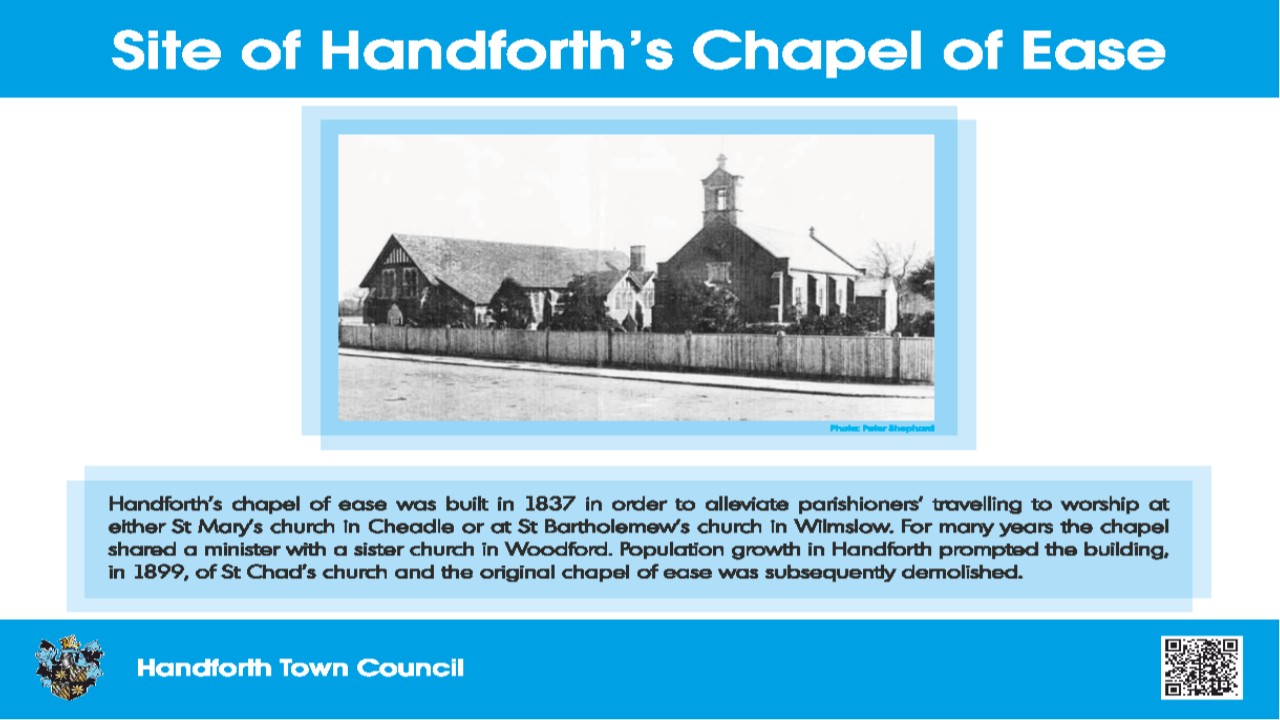
Handforth’s chapel of ease was built in 1837 in order to alleviate parishioners’ travelling to worship at either St Mary’s church in Cheadle or at St Bartholemew’s church in Wilmslow. For many years the chapel shared a minister with a sister church in Woodford. Population growth in Handforth prompted the building, in 1899, of St Chad’s church and the original chapel of ease was subsequently demolished.
Site of The Parsonage
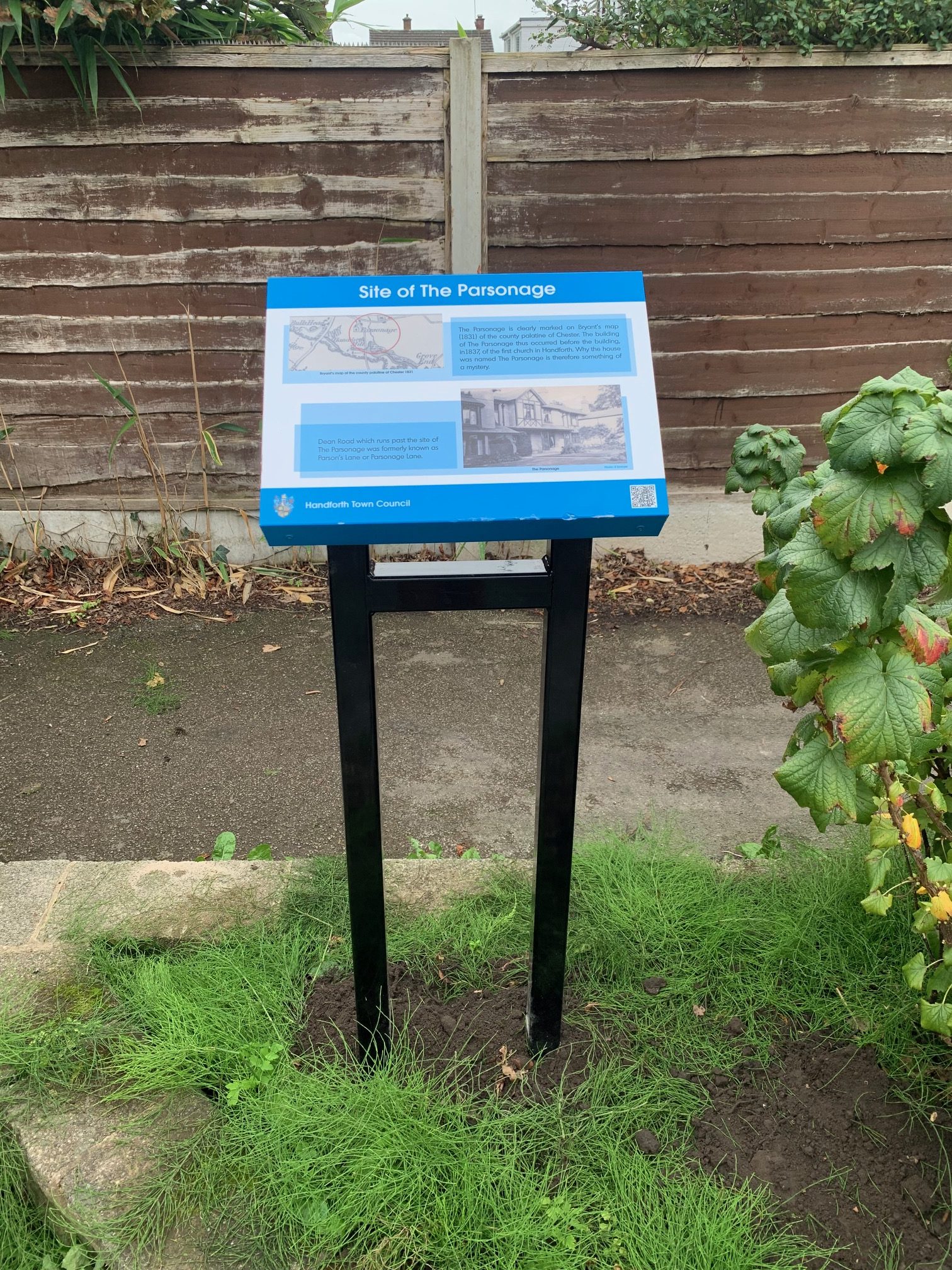

The Parsonage is clearly marked on Bryant’s map (1831) of the county palatine of Chester. The building of The Parsonage thus occurred before the building, in1837, of the first church in Handforth. Why the house was named The Parsonage is therefore something of a mystery.
Dean Road which runs past the site of The Parsonage was formerly known as Parson’s Lane or Parsonage Lane.
The Tank Track


The entrance to this woodland path, locally known as “the tank track”, marks the site of the terminus of a military branch that left the main railway line at a point west of Countess Avenue in the Stanley Green Trading estate. The terminus comprised a loading/unloading dock of four sidings, one of which formed a run-round loop. Concrete remains of the dock are visible in the footpath of Hall Road.
Armoured fighting vehicles unloaded at this site were driven down Brereton Road (reinforced with concrete) and Dean Road to a repair depot
(2 AFC Depot RAOC) located where the Welland Road housing estate now stands. The army branch line to Hall Road opened in 1942 and closed in 1958.
Handforth Hall
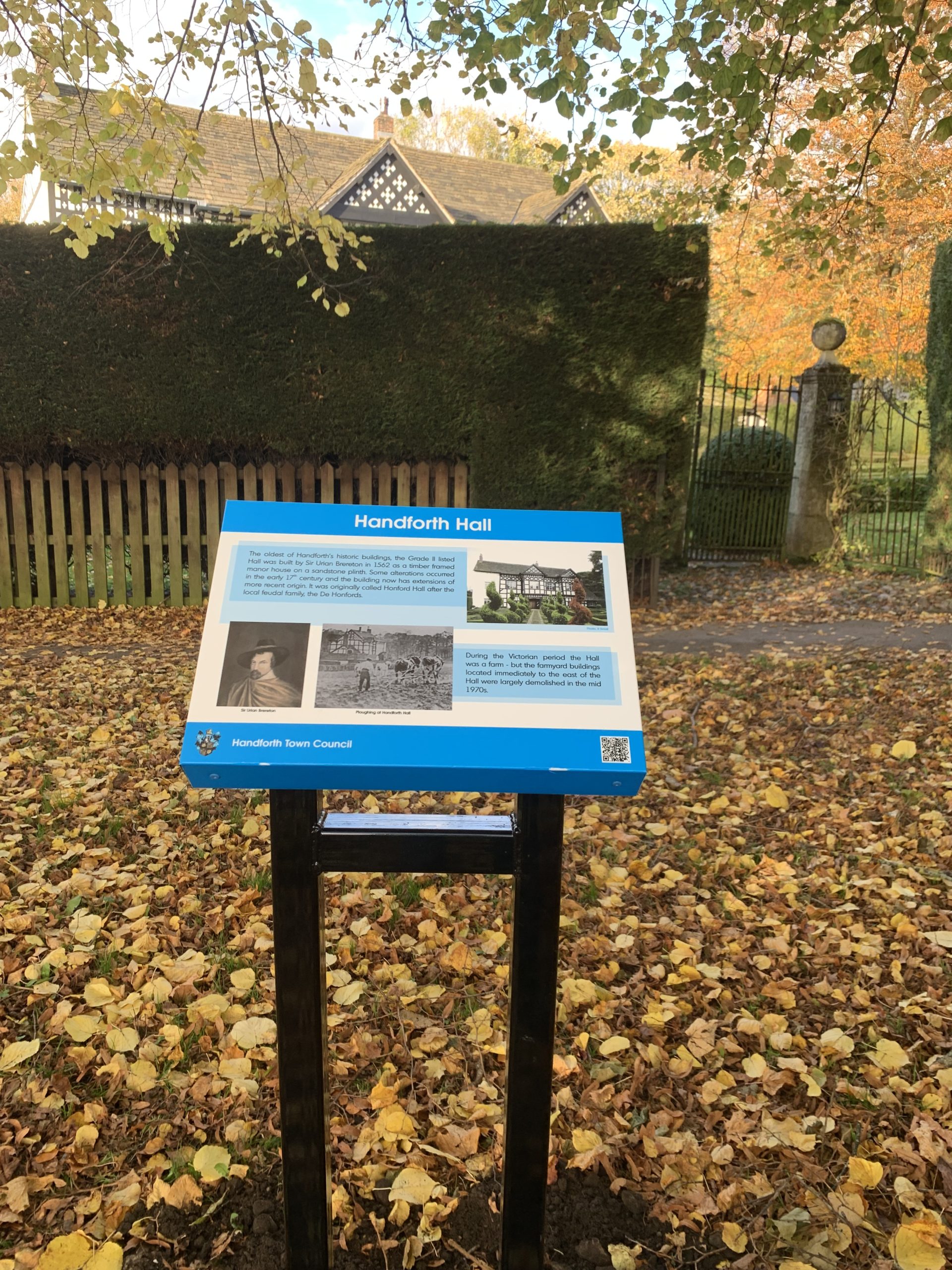

The oldest of Handforth’s historic buildings, the Grade II listed Hall was built by Sir Urian Brereton in 1562 as a timber framed manor house on a sandstone plinth. Some alterations occurred in the early 17th century and the building now has extensions of more recent origin. It was originally called Honford Hall after the local feudal family, the De Honfords. During the Victorian period the Hall was a farm – but the farmyard buildings located immediately to the east of the Hall were largely demolished in the mid 1970s.
The Site of Kilham Chapel
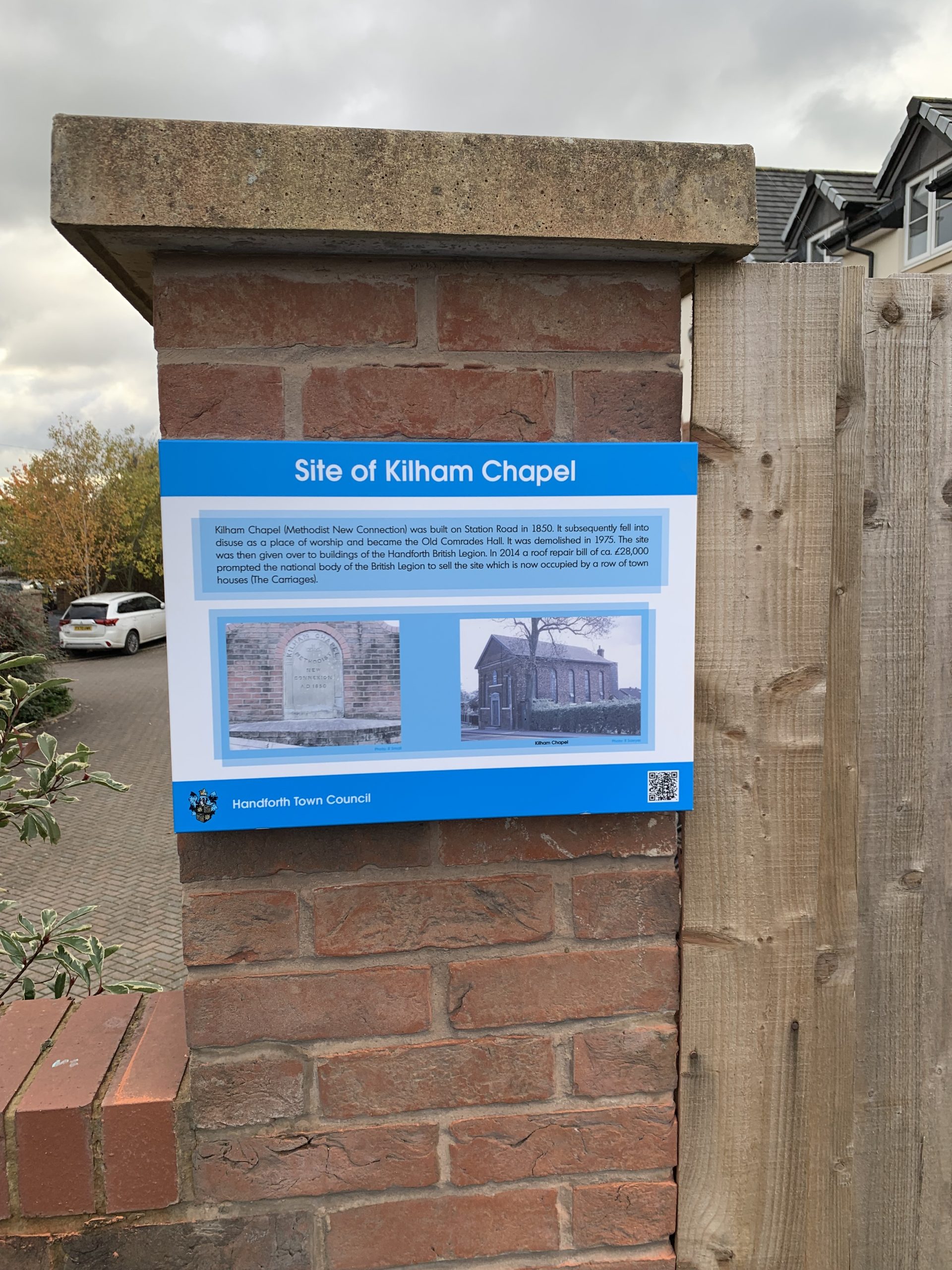

Kilham Chapel (Methodist New Connection) was built on Station Road in 1850. It subsequently fell into disuse as a place of worship and became the Old Comrades Hall. It was demolished in 1975. The site was then given over to buildings of the Handforth British Legion. In 2014 A roof repair bill of ca £28,000 prompted the national body of the British Legion to sell the site which is now occupied by a row of town houses (The Carriages).
Site of Peacock Farm


In latter years Peacock Farm was occupied by members of the Shenton family. The site Included the farmhouse, an area of glasshouses and a barn for the storage of fertiliser and animal fodder. A farm shop operated at the site. All the buildings of Peacock Farm were demolished by 2010.
An Entrance Road for RAF 61 MU


This track (circled in the map shown below) was a subsidiary entrance to the headquarters and sites 5 and 1 of RAF 61MU, a wartime maintenance unit. RAF 61MU was dispersed over multiple sites and, in part, had its own internal railway system.
During World War II the unit supplied the RAF with equipment as varied as mess tins to large aero engine parts. The unit closed in 1959.
